
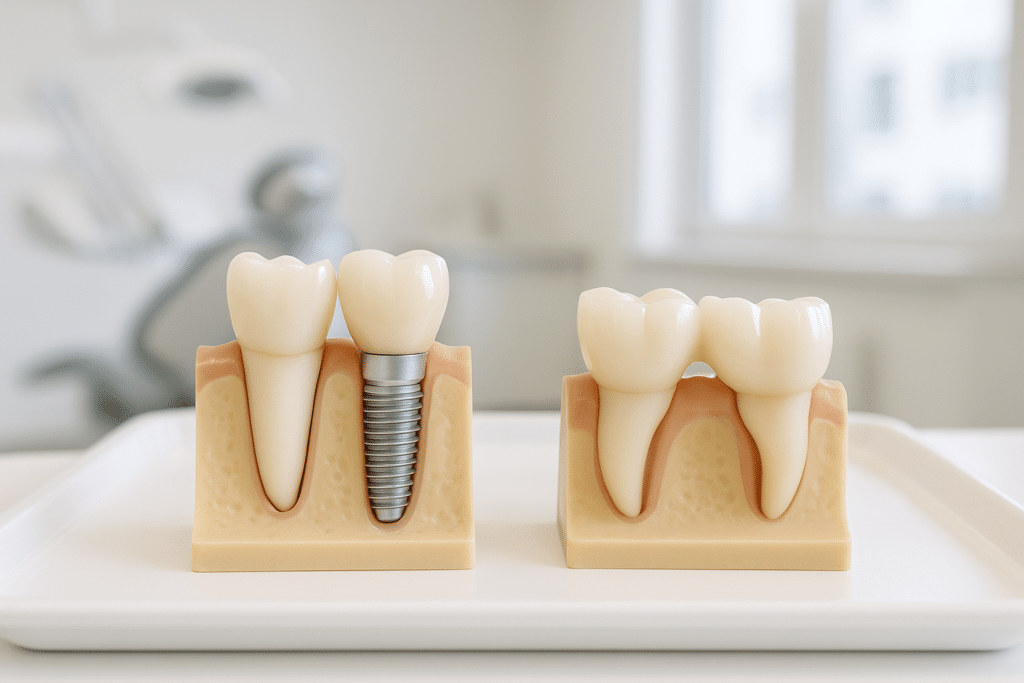
Losing a tooth—whether to decay, injury, or gum disease—can affect far more than your smile. It can change how you chew, how you speak, and how confident you feel day to day. If you are weighing your choices, the conversation almost always comes down to dental implants vs bridges, the two most common ways to replace one or more missing teeth. Both restore function and appearance, but they work in very different ways.
This guide walks you through how each option works, how they compare on durability, bone health, timeline, cost, and daily care, and the personal factors that tend to point toward one over the other. Think of it as a starting point for a more informed conversation with your dentist, who can assess your mouth and help you decide what suits your situation best.
How Each Tooth-Replacement Option Works
Before comparing dental implants vs bridges side by side, it helps to understand what actually happens in your mouth with each approach. The two solutions solve the same problem from opposite directions—one rebuilds from the root up, the other spans the gap using neighbouring teeth for support.
Dental implants
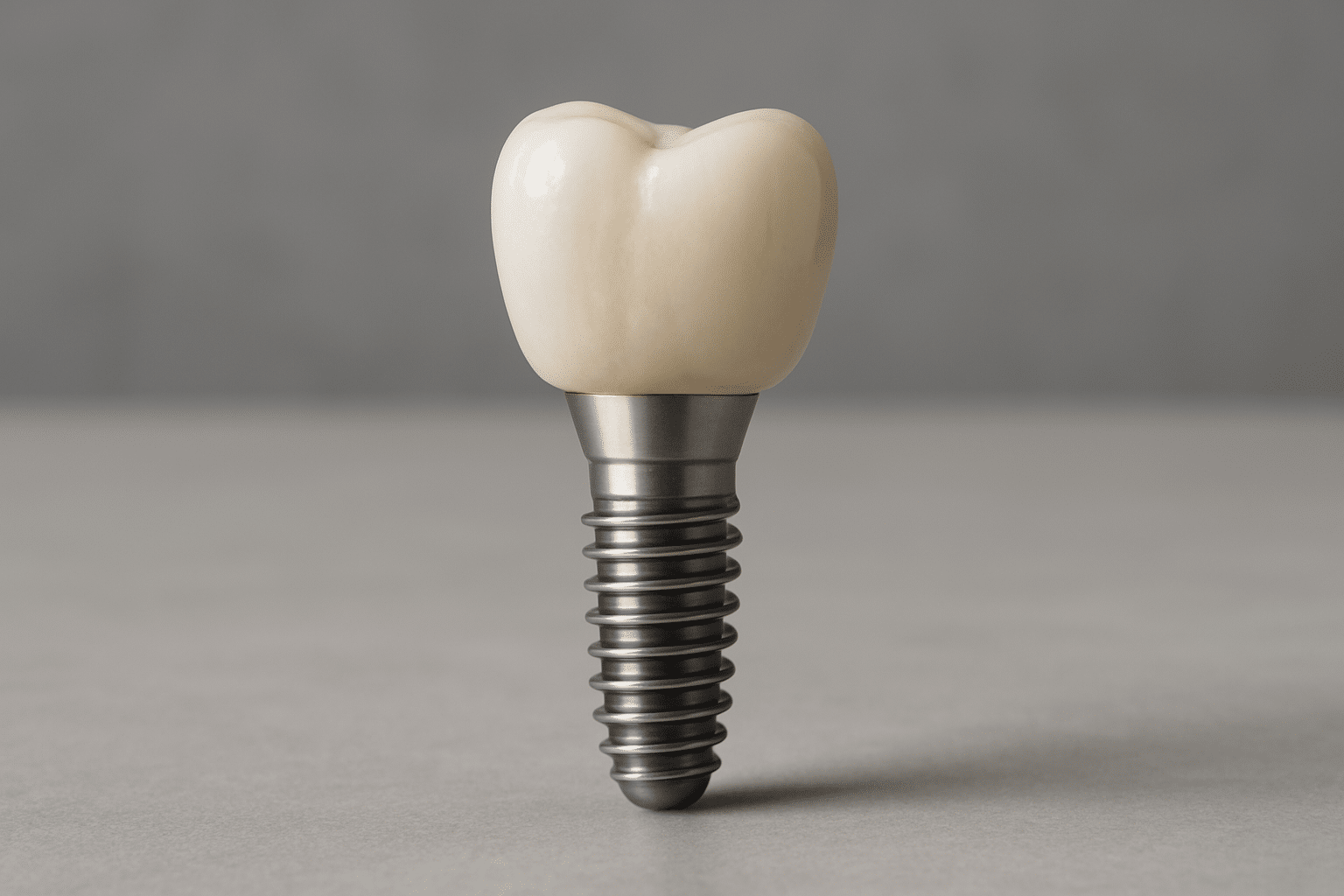
A dental implant replaces the entire tooth, root included. A small, biocompatible post (usually titanium) is placed into the jawbone, where it gradually fuses with the surrounding bone over a period of healing. Once integrated, the post acts as an artificial root. A connector called an abutment is attached, and a custom crown is fitted on top to match your natural teeth in shape and shade. The result is a standalone replacement that does not rely on the teeth around it.
Dental bridges
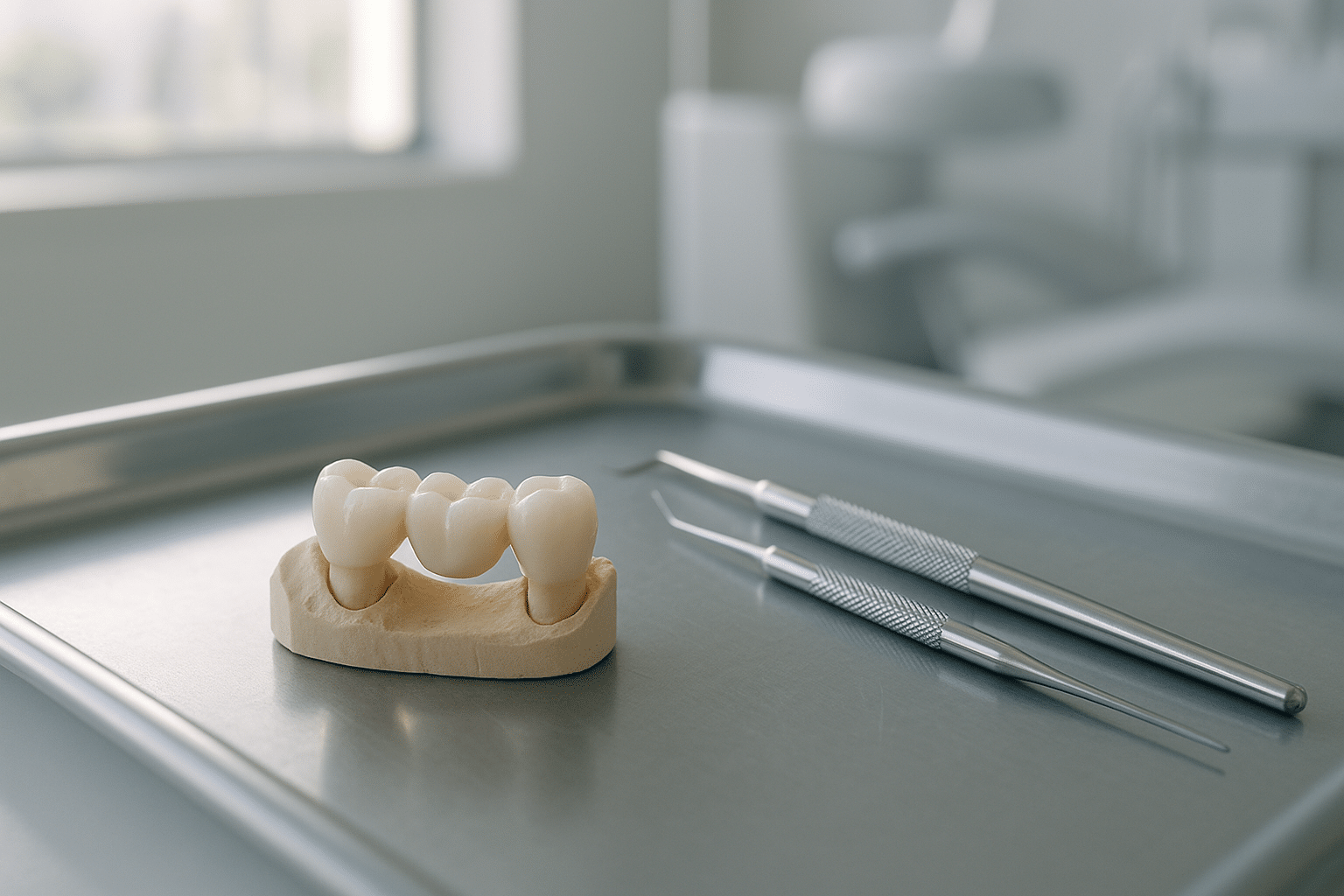
A bridge literally bridges the gap left by a missing tooth. A traditional bridge uses the healthy teeth on either side of the space as anchors. Those teeth are reshaped and fitted with crowns, and a false tooth (called a pontic) is suspended between them. The whole unit is cemented into place as one piece. Because it depends on adjacent teeth, a bridge is a good example of a restoration that works with your existing structure rather than adding a new root.
Comparing Durability and Longevity
One of the first questions people ask is how long each option lasts. While no dental restoration is permanent and results vary from person to person, there are some general patterns worth understanding.
- Dental implants are designed to be a long-term solution. Because the post integrates with your jawbone, a well-maintained implant can serve you for many years, and often decades. The crown on top may eventually need attention from ordinary wear, but the implant itself tends to be very stable.
- Dental bridges typically have a shorter functional lifespan than implants. They can last many years with good care, but because they rely on the supporting teeth and the cement seal, they may need to be replaced sooner. Wear on the anchor teeth over time can also play a role.
Durability is not only about the replacement tooth—it is also about protecting everything around it. That leads directly to a difference many patients do not think about at first: what happens to the bone underneath.
Bone Health and Long-Term Structure
This is one of the most meaningful distinctions in the dental implants vs bridges comparison, and it often surprises people.
When a natural tooth root is present, chewing sends stimulation into the jawbone, which helps the bone stay dense and healthy. When a tooth is lost and the root is gone, that stimulation disappears and the bone in that area can gradually shrink over time—a process called resorption.
- An implant replaces the root, so it continues to stimulate the surrounding bone in a way that helps preserve structure.
- A bridge sits above the gum line and does not replace the root, so it does not provide that same stimulation to the bone beneath the missing tooth.
For patients thinking about the long-term shape of their jaw and face, this is an important point to raise with your dentist. You can learn more about how root-level replacement works on our implant dentistry page.
Procedure and Timeline Differences
How quickly you want to complete treatment—and how many visits you are comfortable with—can strongly influence your choice. The two paths look quite different on a calendar.
The implant timeline
Implants generally involve a longer overall process because of the healing time needed for the post to fuse with the bone. A typical journey might include:
- An initial evaluation, imaging, and planning appointment.
- Placement of the implant post.
- A healing period of several weeks to a few months while integration takes place.
- Placement of the abutment and final custom crown.
The active chair time is usually modest; it is the healing window that extends the timeline.
The bridge timeline
A traditional bridge is often completed more quickly, commonly over a couple of appointments spread across a few weeks:
- Preparing the anchor teeth and taking impressions, often with a temporary bridge fitted.
- Placing and cementing the custom bridge once it has been fabricated.
If a faster turnaround matters to you, a bridge may feel more convenient. If you are prioritizing bone preservation and a standalone restoration, the longer implant timeline may be worth it. Your dentist can help you weigh these trade-offs.
Cost Considerations
Cost is understandably a major factor, and it is rarely as simple as one option being cheaper than the other. Rather than quoting figures—which vary widely based on your specific case, materials, and any preparatory treatment—it helps to think about the value picture over time.
- Upfront cost: Bridges often have a lower initial investment than a single implant, which can make them appealing in the short term.
- Long-term cost: Because implants are built to last and help protect bone, some patients find they represent strong long-term value even if the starting cost is higher.
- Related treatment: Your situation may involve additional considerations, such as the condition of neighbouring teeth or the amount of available bone, which can affect the overall plan.
- Insurance: Coverage differs from one plan to another, so it is worth reviewing your benefits alongside your dentist’s recommendation.
A consultation is the best way to get a picture tailored to you, rather than a general estimate. Patients across Pickering, Ajax, and Whitby often find that seeing the numbers mapped to their own mouth makes the decision much clearer.
Care, Maintenance, and Daily Living
How each restoration fits into your everyday routine is another practical consideration. The good news is that both options are designed to feel natural—but they ask slightly different things of you.
Living with an implant
An implant crown is cared for much like a natural tooth. You brush and floss around it as usual, and it does not require any special adhesives or removal. Because it stands on its own, cleaning between it and neighbouring teeth is straightforward. Regular checkups help your dental team keep an eye on the surrounding gum and bone.
Living with a bridge
A bridge also blends in well, but cleaning underneath the pontic takes a little extra attention. Because the false tooth sits above the gum, food and plaque can gather beneath it, so many patients use a floss threader or a small interdental brush to keep the area clean. Protecting the health of the anchor teeth is especially important, since the bridge depends on them.
Which Option Might Be Right for You?
There is no single answer that fits everyone, which is exactly why a professional evaluation matters. That said, certain factors tend to nudge the decision one way or the other.
A dental implant may be worth exploring if you:
- Want to preserve jawbone and avoid reshaping healthy neighbouring teeth.
- Are looking for a long-term, standalone replacement.
- Have sufficient healthy bone to support the post, or are open to options that build it up.
- Are comfortable with a longer treatment timeline.
A dental bridge may be a good fit if you:
- Prefer a shorter overall timeline and fewer stages.
- Have healthy teeth on either side of the gap that can serve as anchors.
- Are looking for a lower upfront investment.
- Have bone or health considerations that make an implant less suitable right now.
Your overall oral health, medical history, lifestyle, and goals all play a part. A dentist can examine the gap, the neighbouring teeth, and the bone beneath before recommending a path—so the choice is grounded in your individual needs rather than general rules.
To read more about tooth-replacement options in general, the Canadian Dental Association provides reliable oral-health information.
Frequently Asked Questions
Is one option more comfortable than the other?
Both implants and bridges are designed to feel and function much like natural teeth once healing is complete. Comfort can vary from person to person, and factors such as the location of the gap and the health of surrounding tissue play a role. Your dentist can talk through what to expect based on your specific case.
Can a bridge or implant replace more than one missing tooth?
Yes. Bridges can span more than one missing tooth in some situations, and implants can be used individually or to support restorations that replace several teeth. The right configuration depends on how many teeth are missing, where they are, and the condition of the surrounding structure.
Will people be able to tell I have a bridge or an implant?
Both options are made to match the colour and shape of your natural teeth, so they are designed to blend in. A skilled dental team focuses on a natural-looking result, though the final appearance depends on your unique smile and the materials chosen for your restoration.
What if I have been missing a tooth for a long time?
It is still worth having an evaluation. Long-standing gaps can involve some bone loss, which may influence your options, but that does not necessarily rule out any particular treatment. A dentist can assess the area and let you know what is realistic for your situation.
How do I decide between the two?
The most reliable way is a personalized consultation. Reading about dental implants vs bridges is a helpful start, but an in-person exam allows a dentist to weigh your bone health, neighbouring teeth, budget, and goals together before making a recommendation tailored to you.
If you are ready to explore which tooth-replacement option best suits your smile, our team is here to help. Book a consultation at Pickering Square Dental by calling (905) 420-1777, or contact our Pickering office to schedule a visit. We proudly welcome patients from Pickering, Ajax, Whitby, and Scarborough, and we would be glad to help you find the solution that feels right for you.

About Dr. Marvin Lean, DDS
Dr. Marvin Lean, DDS, is the owner and lead dentist at Pickering Square Dental. With decades of experience in family and laser dentistry, Dr. Lean provides care focused on clear communication and patient comfort. He is a member of the Ontario Dental Association (ODA) and the Canadian Dental Association (CDA). Dr. Lean and his team provide comprehensive dental care including sedation dentistry, dental implants, emergency dental care, and the Canadian Dental Care Plan (CDCP) to patients in Pickering, Ajax, Whitby, Scarborough, Oshawa, and Markham. Dr. Lean spent the last 20 years as the Dentist for the Toronto Maple Leafs.