
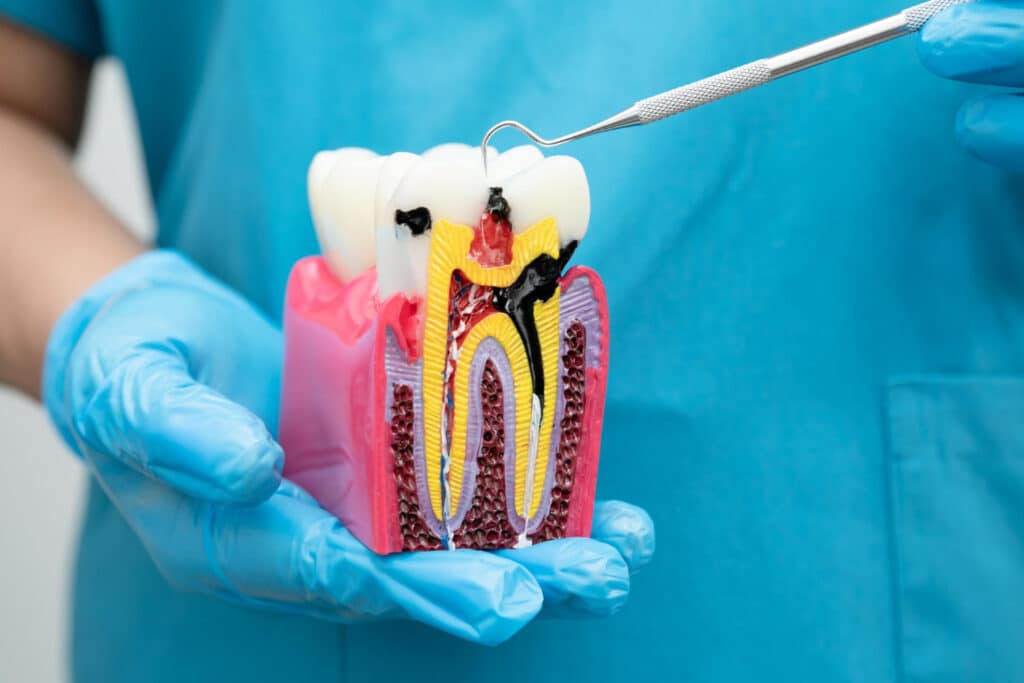
When a tooth is badly decayed, cracked, or infected, patients often ask whether they need a root canal or an extraction. Both treatments can relieve pain and address infection risk, but they lead to very different outcomes. A root canal is meant to save the natural tooth when it can be restored. An extraction removes the tooth when saving it is not predictable, not advisable, or not possible.
The right choice depends on the condition of the tooth, the surrounding bone and gums, your overall health, your bite, the cost and timing of treatment, and your long-term replacement options if the tooth is removed. At Pickering Square Dental, the decision begins with diagnosis, not guesswork.
What Root Canal Therapy Does
Root canal therapy treats infection or inflammation inside the tooth. The dentist or endodontic provider removes diseased pulp tissue, cleans and shapes the canals, seals the space, and restores the tooth. Many root canal treated back teeth also need a crown afterward because the remaining tooth structure may be weakened.
The American Dental Association explains that root canal therapy can help save diseased or injured teeth that might otherwise need removal. Saving a natural tooth can help preserve chewing function, spacing, and bite stability when the tooth is restorable and periodontal support is adequate.
When Extraction May Be Recommended
Extraction may be recommended when the tooth is fractured below the gumline, has too little healthy structure left, has severe bone loss, cannot be restored predictably, or is causing recurrent infection. Wisdom teeth may be removed because of pain, infection, decay, gum disease, cyst risk, or damage to neighbouring teeth. In other cases, extraction may be part of orthodontic or denture planning.
Extraction can solve the immediate tooth problem, but it creates a new question: should the missing tooth be replaced? Depending on the location, missing teeth may affect chewing, speech, appearance, and movement of nearby teeth. Replacement options can include a bridge, partial denture, complete denture, or implant, depending on the case.
What to Expect During Each Treatment
Knowing what each procedure actually involves can take some of the fear out of the decision. A root canal is usually carried out with the tooth fully numbed, and despite its reputation, most patients describe it as similar to having a filling, just longer. The provider creates a small opening, removes the inflamed or infected tissue from inside the canals, cleans and shapes the space, and seals it. A back tooth often then needs a crown to protect what remains, which is typically a separate appointment. Mild tenderness for a few days afterward is common and usually settles.
An extraction is also done under local anesthetic, so the area is numb during the removal. A simple extraction can be quick, while a surgical extraction or a wisdom tooth may take longer and involve a few stitches. Afterward, the focus shifts to protecting the blood clot in the socket and allowing the gum to heal. Both procedures are routine, and in both cases the discomfort people fear in advance is generally well managed with anesthetic during treatment and straightforward aftercare afterward.
How Dentists Evaluate the Tooth
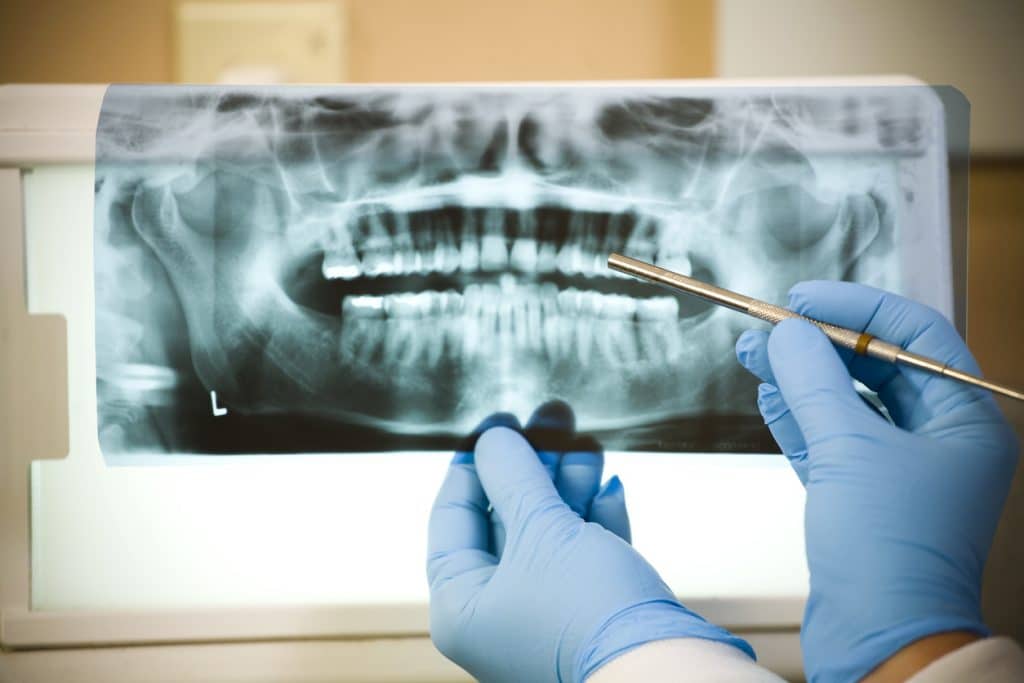
The dentist examines symptoms, takes X-rays when needed, checks gum pockets, tests biting and temperature response, and looks for cracks or swelling. A tooth that looks small above the gum may still have enough structure to restore, or it may not. A tooth that hurts badly may still be saveable if the root, bone, and crown structure are favourable.
Diagnosis also considers the patient. Medical conditions, medications, healing ability, anxiety level, finances, and ability to return for follow-up care can all affect planning. Good dentistry is not only about whether a procedure can be done; it is about whether the result is likely to serve the patient well.
Comparing Time and Follow-Up

Root canal therapy may require one or more appointments, followed by a filling or crown. If pain is severe, emergency treatment may begin with medication, drainage, or a temporary step before definitive care. Extraction may be faster initially, but replacement planning can take more time later.
Patients sometimes choose extraction because it seems simpler in the moment. That may be appropriate in some cases, but it is important to understand the full sequence. Removing a tooth without replacing it can lead to bite changes over time. Replacing the tooth can add appointments and cost. Your dentist should explain both the immediate and long-term implications.
Pain Relief and Infection Control
Both root canal therapy and extraction can address dental infection, but antibiotics alone usually do not solve the source of a tooth infection. Medication may help in selected cases, but the underlying tooth problem still needs treatment. If swelling, fever, or difficulty swallowing is present, care should be urgent.
Severe dental pain should not be managed with repeated painkillers while waiting for it to disappear. Pain may come and go even when the tooth is still infected or structurally compromised. A dental exam is the only way to know what is happening.
Which Option Is Better?
Neither treatment is automatically better. If a tooth can be saved predictably, root canal therapy plus proper restoration may preserve natural function. If the tooth has a poor prognosis, extraction may be the healthier and more realistic choice. The best answer is specific to the tooth and the patient.
If you are comparing root canal therapy and extraction in Pickering, call Pickering Square Dental at (905) 420-1777. You can also visit our root canal therapy and dental extraction pages to review related services.
For further reading, the Canadian Dental Association’s oral health resources provide general background on common dental treatments and how to keep your teeth healthy.
Thinking About the Long-Term Picture
One of the most important parts of this decision is looking beyond the immediate appointment. Saving a natural tooth with a root canal, when the tooth is restorable, preserves your own structure and keeps your bite and neighbouring teeth in their proper places. A treated and crowned tooth can serve well for many years. The trade-off is that it usually involves more than one visit and the cost of the restoration on top of the root canal itself.
Extraction resolves the problem tooth more quickly, but it opens a second question: what happens to the space. A missing tooth can allow neighbouring teeth to drift and the opposing tooth to shift over time, which may affect chewing and bite balance. Replacing it with a bridge, partial denture, or implant restores function but adds appointments and expense of its own. This is why we encourage patients to compare the complete treatment path, including replacement, rather than only the first step. Choosing the cheaper or faster option in the moment is not always the more economical choice once the full sequence is considered.
Why a Proper Diagnosis Comes First
It is worth emphasizing that neither treatment can be chosen responsibly from symptoms alone. Two teeth that hurt in similar ways can have very different prognoses once we examine them. We look at how much healthy tooth structure remains, whether a crack extends below the gumline, the level of bone support, the results of bite and temperature tests, and what imaging reveals about the roots and surrounding bone. A tooth that feels hopeless to the patient is sometimes quite saveable, and one that looks fine on the surface is sometimes not.
The patient matters as much as the tooth. Your medical history, healing ability, anxiety level, budget, and willingness to return for follow-up care all factor into a plan that will actually serve you well. Good dentistry is not just about whether a procedure is technically possible, but whether the result is likely to last and suit your life. Everything in this article is general background. The right choice between a root canal and an extraction for your specific tooth can only be determined through an examination, which is the conversation we would genuinely encourage rather than a decision made in advance.
Frequently Asked Questions
Is extraction cheaper than a root canal?
Extraction may cost less initially, but replacing the missing tooth can add cost later. Compare the complete treatment path, not only the first appointment.
Can every infected tooth be saved?
No. A tooth must have enough structure, support, and restorability. Severe cracks, bone loss, or decay can make extraction the better option.
Will antibiotics fix a tooth infection?
Antibiotics may help selected infections, but they usually do not remove the source inside the tooth. Dental treatment is still needed.

About Dr. Marvin Lean, DDS
Dr. Marvin Lean, DDS, is the owner and lead dentist at Pickering Square Dental. With decades of experience in family and laser dentistry, Dr. Lean provides care focused on clear communication and patient comfort. He is a member of the Ontario Dental Association (ODA) and the Canadian Dental Association (CDA). Dr. Lean and his team provide comprehensive dental care including sedation dentistry, dental implants, emergency dental care, and the Canadian Dental Care Plan (CDCP) to patients in Pickering, Ajax, Whitby, Scarborough, Oshawa, and Markham. Dr. Lean spent the last 20 years as the Dentist for the Toronto Maple Leafs.