
Professional Teeth Whitening vs At-Home Kits: Which Works Better?

Teeth Whitening

Why Teeth Whitening Has Become So Popular

A bright, white smile is one of the most requested cosmetic dental treatments in Canada — and for good reason. Stained or discoloured teeth can make you feel self-conscious about your appearance, and a whiter smile often boosts confidence in both personal and professional settings. But with so many options on the market — from dental office treatments to drugstore strips and social media LED kits — deciding between professional teeth whitening vs home kits can feel overwhelming. At Pickering Square Dental, our team helps patients from Oshawa, Pickering, Ajax, and across the Durham Region make informed choices about whitening treatments that deliver real, lasting results without compromising their oral health.

The truth is, both professional and at-home whitening can lighten your teeth. But they differ significantly in strength, speed, safety, customization, and long-term results. Understanding these differences will help you choose the approach that best fits your goals, budget, and dental health.

Teeth Whitening

How Professional In-Office Whitening Works

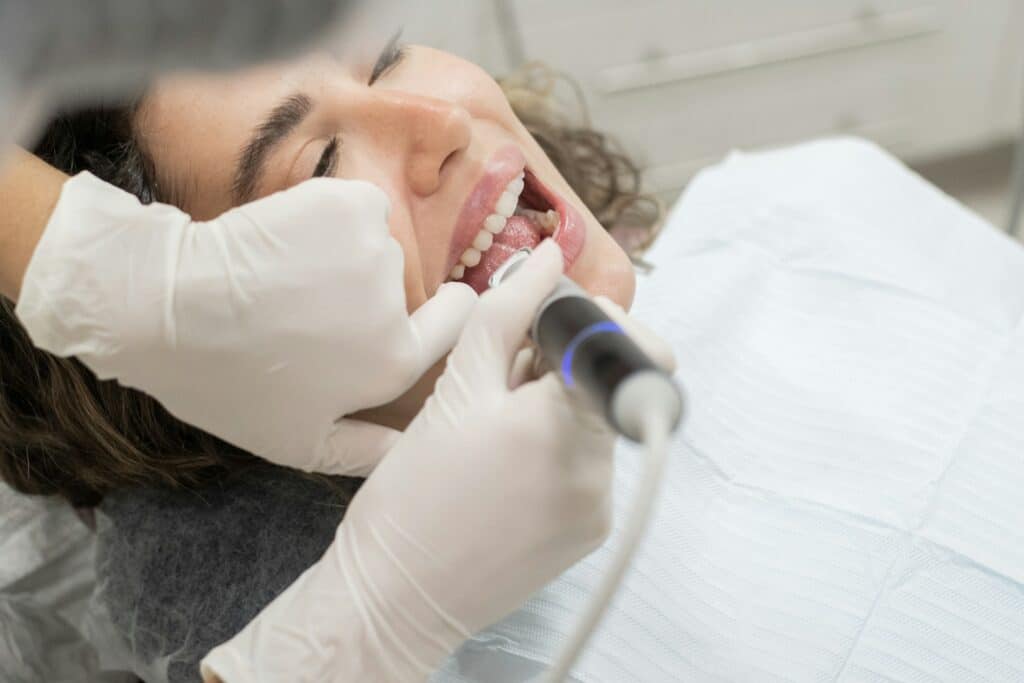
Professional teeth whitening performed at a dental office uses prescription-strength bleaching agents — typically hydrogen peroxide or carbamide peroxide at concentrations between 25% and 40%. These concentrations are significantly higher than anything available over the counter, which is why they deliver faster, more dramatic results.

Here is what a typical in-office whitening appointment looks like:

  • Examination and preparation: Your dentist examines your teeth and gums to ensure you are a good candidate for whitening. Any cavities, gum disease, or exposed roots are addressed first, as bleaching agents can cause pain or damage to compromised teeth.
  • Gum protection: A protective barrier — usually a rubber dam or a light-cured resin — is applied to your gums to shield them from the concentrated bleaching gel.
  • Whitening gel application: The professional-grade gel is carefully applied to the front surfaces of your teeth.
  • Light activation (in some systems): Some whitening systems use a special LED or laser light to accelerate the bleaching process. The evidence on whether light activation provides additional benefit is mixed, but many systems use it as part of their protocol.
  • Multiple rounds: The gel is typically applied in two to three rounds of 15 to 20 minutes each, with fresh gel used for each round.
  • Results: Most patients see their teeth lighten by three to eight shades in a single visit lasting 60 to 90 minutes.

Professional whitening also offers the advantage of customization. Your dentist can target specific teeth that are more discoloured, adjust the concentration based on your sensitivity level, and monitor the process to ensure even results.

How At-Home Whitening Kits Work

At-home whitening kits come in several forms, each with different active ingredients, concentrations, and application methods:

Whitening strips: Thin, flexible plastic strips coated with a hydrogen peroxide gel (typically 6% to 14% concentration). You press them onto your teeth for 30 minutes once or twice daily for one to three weeks. Strips are the most popular over-the-counter option and generally deliver modest results.

Whitening trays and gels: Some kits include a one-size-fits-all tray that you fill with whitening gel and wear for a set amount of time. The trays do not fit as precisely as custom ones from a dentist, which can lead to uneven whitening and gel leaking onto your gums, causing irritation.

LED whitening devices: These kits include a mouthpiece with built-in LED lights and a whitening serum. Marketed heavily on social media, they claim the light accelerates the whitening process. However, at the low concentrations used in these consumer products, the light’s effect is minimal, according to the Canadian Dental Association.

Whitening toothpastes and rinses: These products contain mild abrasives or very low concentrations of peroxide that can remove surface stains over time. They do not change the intrinsic colour of your teeth and are best used for maintenance after a professional whitening treatment, not as a primary whitening method.

Dentist-dispensed take-home trays: This is a middle-ground option that combines the convenience of at-home use with the customization of professional care. Your dentist takes impressions of your teeth and creates custom-fitted whitening trays. You fill them with a professional-grade gel (typically 10% to 22% carbamide peroxide) and wear them for 30 minutes to a few hours daily for one to three weeks. These deliver better results than over-the-counter kits because the custom fit ensures even gel distribution and minimal gum contact.

Teeth Whitening

Professional Teeth Whitening vs Home Kits: Key Factors

To help you decide which option is right for you, here is a side-by-side comparison of the most important factors:

Speed of results: Professional in-office whitening delivers visible results in a single appointment — usually 60 to 90 minutes. At-home kits require consistent daily use over one to three weeks before you see significant improvement. If you have an event coming up, professional whitening is the faster path.

Degree of whitening: In-office treatments can lighten teeth by three to eight shades. Over-the-counter strips typically lighten by one to three shades. Custom take-home trays from your dentist fall in between, offering four to six shades of improvement with consistent use.

Safety and supervision: When a dentist performs or supervises your whitening, they first check for issues that could cause complications — untreated cavities, cracked teeth, receding gums, or worn enamel. Bleaching agents on compromised teeth can cause sharp pain or further damage. With store-bought products, you are on your own. Overuse or misuse of at-home kits is one of the most common causes of tooth sensitivity and chemical gum burns.

Evenness of results: Professional treatments and custom trays deliver consistent, even whitening because the gel is applied precisely. One-size-fits-all strips and trays often produce uneven results — the centres of teeth whiten more than the edges, and crooked or overlapping teeth may not be reached by the gel at all.

Longevity: Both professional and at-home whitening results are temporary and require maintenance. Professional results typically last 6 to 12 months with good oral hygiene and dietary habits. Store-bought kit results may last three to six months. Regardless of the method, consuming coffee, tea, red wine, or tobacco will accelerate staining.

Cost: This is where at-home kits have a clear advantage. Over-the-counter strips cost $30 to $80 per box. Professional in-office whitening ranges from $300 to $700. Custom take-home trays from a dentist typically cost $250 to $500. While professional treatment has a higher upfront cost, many patients find the superior results and safety worth the investment.

Safety Considerations and Who Should Avoid Whitening

Teeth whitening is generally safe when used as directed, but it is not appropriate for everyone. Consider these important safety points:

  • Tooth sensitivity: Both professional and at-home whitening can cause temporary sensitivity to cold temperatures. If you already have sensitive teeth, your dentist can recommend a desensitizing treatment before and after whitening to minimize discomfort.
  • Enamel damage from overuse: Using whitening products too frequently or leaving them on longer than directed can weaken tooth enamel over time. Follow product instructions exactly and resist the urge to “double up” for faster results.
  • Gum irritation: Whitening gel that contacts your gums can cause a chemical burn, resulting in white, painful patches that typically heal within a few days. Custom trays and professional application minimize this risk.
  • Not effective on all types of discolouration: Whitening works best on extrinsic stains (caused by food, drink, and tobacco). Intrinsic discolouration — caused by medications like tetracycline, fluorosis, or trauma — may not respond well to bleaching. Your dentist can advise whether whitening will work for your specific type of staining.

You should avoid whitening if you:

  • Are pregnant or breastfeeding.
  • Have untreated cavities or active gum disease.
  • Have dental restorations (crowns, veneers, bonding) on your front teeth — these materials do not whiten and will stand out against your bleached natural teeth.
  • Are under 16 years of age, as the tooth pulp is still developing.

teeth whitening

Frequently Asked Questions About Teeth Whitening

Does whitening damage your enamel?

When used correctly and under professional guidance, teeth whitening does not permanently damage enamel. Studies published in peer-reviewed dental journals have shown that professionally supervised whitening is safe for tooth structure. However, overusing over-the-counter products or using them incorrectly can lead to enamel erosion and increased sensitivity. Always follow the recommended usage instructions and consult your dentist if you are unsure.

How long do whitening results last?

Results vary based on your dietary habits, oral hygiene, and the type of whitening performed. Professional treatments generally last 6 to 12 months, while over-the-counter results may fade within three to six months. You can extend your results by avoiding staining foods and beverages, using a whitening toothpaste for maintenance, and scheduling periodic touch-up treatments.

Can I whiten my teeth if I have crowns or fillings?

Whitening products only work on natural tooth enamel. Crowns, fillings, veneers, and bonding will not change colour with bleaching agents. If you have restorations on visible front teeth, whitening your natural teeth may create a colour mismatch. Your dentist can discuss options such as replacing older restorations to match your newly whitened teeth.

Is charcoal toothpaste effective for whitening?

Charcoal toothpastes have become trendy, but the Canadian Dental Association has not endorsed them for whitening. These products work by abrading the surface of your teeth to remove surface stains, but they do not change the underlying colour of your enamel. In fact, the abrasiveness can wear down enamel over time, making your teeth look yellower as the darker dentin layer beneath becomes more visible.

Brighten Your Smile at Pickering Square Dental

Whether you are weighing professional teeth whitening vs home kits or need expert guidance on the right approach, the best place to start is with a consultation. At Pickering Square Dental, we help patients from Oshawa, Pickering, Ajax, Whitby, Scarborough, and Markham achieve their whitening goals safely and effectively. Dr. Marvin Lean and our team will assess your teeth, discuss your expectations, and recommend the approach that will give you the best results. Call us today at (905) 420-1777 to book your whitening consultation.

How Much Do Dental Implants Cost in Pickering?
Dental Implants

Dental Implant Cost Pickering: What You Will Actually Pay

If you are researching dental implant cost Pickering clinics charge, you have probably noticed that pricing information online is vague and varies widely. That is because the cost of dental implants depends on several factors that are unique to each patient — the number of implants needed, whether bone grafting is required, the type of restoration placed on top, and the materials used. At Pickering Square Dental, we believe in transparent pricing so that our patients from Pickering, Markham, Ajax, Scarborough, and across the Durham Region can make informed decisions about restoring their smiles with dental implants.

This guide breaks down the real costs of dental implants in the Pickering area, explains what affects pricing, covers insurance and financing options, and helps you understand why implants are widely considered the gold standard for replacing missing teeth.

Dental Implant

Dental Implant Price Breakdown by Type

The total cost of a dental implant includes several components: the implant post (a titanium screw placed into the jawbone), the abutment (the connector piece), and the crown or prosthesis (the visible tooth). Here is what you can expect to pay in the Pickering and Durham Region area:

Single tooth implant: $3,000 to $6,000

This covers the complete treatment from start to finish — the surgical placement of one titanium implant, the abutment, and a custom porcelain crown. The wide price range reflects differences in case complexity. A straightforward implant in healthy bone with no complications falls at the lower end. Cases requiring bone grafting, sinus lift, or additional imaging push the cost toward the higher end.

Implant-supported bridge (replacing 3-4 teeth): $6,000 to $12,000

When multiple adjacent teeth are missing, an implant-supported bridge is often more cost-effective than placing individual implants for each tooth. Two implants are placed at either end of the gap, and a bridge of connected crowns spans between them. This approach replaces three to four teeth using only two implant posts.

Full-arch restoration / All-on-4 (replacing all teeth): $20,000 to $30,000+ per arch

For patients who are missing all or most of their teeth in one jaw, the All-on-4 concept uses four strategically placed implants to support a full arch of fixed prosthetic teeth. This is a life-changing procedure that replaces an entire row of teeth with a permanent, non-removable set that looks, feels, and functions like natural teeth. The cost varies based on the materials used (acrylic vs. zirconia), whether extractions and bone grafting are needed, and the complexity of the case.

It is important to understand that the costs listed above are estimates. Your actual investment will depend on the specifics of your case, which your dentist will determine after a thorough examination and diagnostic imaging.

What Factors Affect the Cost of Dental Implants?

Several variables influence the final price of your dental implant treatment:

Bone grafting: When a tooth has been missing for a long time, the jawbone in that area often deteriorates due to lack of stimulation. If there is not enough healthy bone to support an implant, a bone graft is needed to rebuild the area. Bone grafting adds $500 to $3,000 to the total cost, depending on the type and extent of grafting required. Common types include socket preservation grafts, ridge augmentation, and sinus lifts.

Diagnostic imaging: Precise implant placement requires detailed imaging. A cone beam CT (CBCT) scan provides a three-dimensional view of your jawbone, nerves, and sinuses, allowing your dentist to plan the exact placement of each implant. A CBCT scan typically costs $200 to $500.

Number of implants: More implants mean higher costs, but strategic placement can reduce the number needed. For example, the All-on-4 concept uses just four implants to support an entire arch, making full-mouth restoration more affordable than placing eight to ten individual implants.

Implant material: Most dental implants are made of titanium, which has a decades-long track record of success and biocompatibility. Some patients prefer zirconia (ceramic) implants, which are metal-free and white in colour. Zirconia implants tend to cost slightly more than titanium.

Type of crown or prosthesis: The restoration placed on top of the implant also affects cost. A standard porcelain-fused-to-metal crown costs less than an all-ceramic or zirconia crown. For full-arch restorations, zirconia hybrid prostheses are more durable and natural-looking than acrylic options, but they come at a higher price point.

Tooth extractions: If damaged or decayed teeth need to be removed before implant placement, extraction fees ($150 to $400 per tooth for simple extractions, more for surgical extractions) add to the overall cost.

Sedation: Patients who opt for IV sedation or oral sedation during implant surgery will incur additional sedation fees, typically $300 to $800 depending on the type and duration of sedation.

Dental Implants

Insurance Coverage and Financing Options

One of the most common questions patients ask is whether dental insurance covers implants. The answer depends on your specific plan:

Private dental insurance: Many employer-sponsored and private dental plans in Ontario cover a portion of dental implant costs — often 50% of the surgical component (implant placement) and 50% of the crown, up to your annual maximum. However, some plans classify implants as a “major” or “elective” procedure and may have waiting periods, frequency limits, or specific exclusions. Our team at Pickering Square Dental will help you understand your coverage before treatment begins by submitting a pre-authorization to your insurance company.

Canadian Dental Care Plan (CDCP): The federal Canadian Dental Care Plan provides coverage for eligible Canadians who do not have private dental insurance. While the plan does cover many dental services, coverage for implants specifically may vary. Check your eligibility and coverage details on the Government of Canada website or ask our office to verify on your behalf.

Financing and payment plans: To make dental implants more accessible, many dental practices — including Pickering Square Dental — offer flexible payment plans or partner with third-party financing companies. These options allow you to spread the cost of treatment over several months with manageable monthly payments, often with low or no interest for qualifying patients.

Health Spending Accounts (HSAs) and tax deductions: If you have a Health Spending Account through your employer, dental implant costs are generally eligible. Additionally, dental expenses exceeding a certain threshold can be claimed as a medical expense tax credit on your Canadian income tax return.

Why Dental Implants Are Worth the Investment

The upfront cost of dental implants is higher than dentures or bridges, which leads some patients to choose these alternatives. However, when you look at the full picture — longevity, oral health benefits, quality of life, and lifetime costs — implants are often the most cost-effective option in the long run.

Longevity: Dental implants are designed to last a lifetime with proper care. Studies show that implant success rates exceed 95% over a 10-year period, and many implants last 25 years or more. Dentures and bridges, by comparison, typically need replacement every 5 to 15 years, adding up in cost over time.

Bone preservation: When a tooth is lost, the jawbone in that area begins to deteriorate because it no longer receives stimulation from the tooth root. This bone loss can change your facial structure over time, leading to a sunken, aged appearance. Dental implants are the only tooth replacement option that mimics the natural tooth root and stimulates the jawbone, preventing bone loss.

No damage to adjacent teeth: A traditional dental bridge requires grinding down the two healthy teeth on either side of the gap to serve as anchors. This permanently compromises those teeth. Implants stand independently — they do not rely on or damage neighbouring teeth.

Function and comfort: Implants function exactly like natural teeth. You can eat all the foods you enjoy — including hard and crunchy items that are off-limits with dentures — without worrying about slipping or discomfort. There is no adhesive, no soaking overnight, and no bulky palate coverage.

Aesthetics: A well-placed implant with a quality crown is virtually indistinguishable from a natural tooth. The crown is custom-shaped and colour-matched to blend seamlessly with your surrounding teeth.

Confidence: Perhaps most importantly, dental implants restore confidence. You can smile, speak, and eat in public without worrying about your teeth shifting, clicking, or falling out.

Dental Implants

Frequently Asked Questions About Dental Implant Costs

Is there a cheaper alternative to dental implants?

Yes, traditional dentures and dental bridges cost less upfront. A conventional denture may cost $1,000 to $3,000, and a three-unit bridge typically costs $2,500 to $5,000. However, these options need to be replaced periodically and do not prevent bone loss. When you factor in replacement costs over a lifetime, implants are often comparable in total cost — and they offer significantly better function, comfort, and oral health outcomes.

Can I get dental implants if I have bone loss?

Yes, in most cases. Bone grafting procedures can rebuild the jawbone to provide a solid foundation for implant placement. While this adds time and cost to the overall treatment, it makes implants possible for many patients who were previously told they did not have enough bone. Advanced techniques like zygomatic implants can also be used in cases of severe bone loss in the upper jaw.

How long does the dental implant process take from start to finish?

The complete dental implant process typically takes four to nine months. After the implant is surgically placed, a healing period of three to six months is needed for the implant to fuse with the jawbone (a process called osseointegration). Once healed, the abutment and crown are placed over one or two additional appointments. If bone grafting is required, add three to six months of healing time before implant placement.

Do dental implants hurt?

The implant surgery itself is performed under local anaesthesia, so you should not feel pain during the procedure. Sedation options are available for patients who want additional comfort. After surgery, mild to moderate discomfort is normal for a few days and is manageable with over-the-counter pain medication. Most patients report that the discomfort is less than they expected — similar to having a tooth extracted.

How do I care for dental implants?

Caring for dental implants is similar to caring for natural teeth — brush twice daily, floss daily (or use an interdental brush around the implant), and visit your dentist for regular checkups and cleanings. While implants cannot develop cavities, the gum tissue around them can become inflamed (peri-implantitis) if not kept clean. With proper care, your implants should last for decades.

Get a Personalized Dental Implant Quote

Every patient’s situation is different, and the only way to know your exact dental implant cost Pickering residents can expect is through a comprehensive consultation. At Pickering Square Dental, Dr. Marvin Lean and our team provide detailed treatment plans with transparent pricing — no hidden fees, no surprises. We serve patients from Pickering, Markham, Ajax, Whitby, Scarborough, and Oshawa. Call us today at (905) 420-1777 to schedule your dental implant consultation and take the first step toward a permanent, confident smile.